Internet Radio 2016
How to launch and operate
your own radio station
An Online Radio "how to" guide, explaining how to set up and run all kinds of streaming media and your own Internet radio station.
The book began life as an eBook that can be read on Kindles, tablets, computers and any smartphone.
The guide describes all the equipment needed, why and where it can be obtained; in many cases the price details are included and even has direct clickable links to the various suppliers.
By living in Florida during the construction of the Laser radio ship Paul was subject only to US laws, and so not breaking any of the UK regulations, which normally prohibit such work.
Pirate Publications' first issue was The Lid Off Laser 558 (ISBN 0-948055-00-6) in 1984 followed by a "Who's Who in British Radio" (ISBN 1900401045) in 1986, jointly with his daughter Dawn.
The Lid off Laser 558 was written about the setting up of offshore radio station LASER 558, which was an incredibly successful radio station in the mid 1980s. By living in Florida during construction of the radio ship (at Port Everglades) Paul was subject only to US laws, and so not breaking the UK legislation, which normally prohibits such work.
Paul's first published work
Paul's first commissioned article was in 1973 for a radio magazine, aimed at radio listeners in the UK and called SCRIPT. In the article Paul told of his life on Radio Caroline.
He wrote many further pieces over the years for titles as diverse as Practical Wireless, Ships Monthly and Billboard in the 1970s. The largest of these was a four page spread in Ships Monthly in the early 1980's which won two awards.
In the 1980's he also worked for the Yorkshire Post as a stringer and for the Sunday Times. His ST work included many commissioned articles, mostly about radio but also some items about the music business.
World Broadcast News
Paul then became the UK correspondent for World Broadcast News throughout the 1980s. World Broadcast News was a leading American publication covering radio stations around the world.
Mix Mag
In 1984 he was invited by Tony Prince to write for DMC (Disco Mix Club) - a glossy mag aimed at DJs and the clubbing scene. His occasional radio pieces were expanded into a regular monthly 'column' which eventually covered several pages of news from the radio business around the world.
Paul also chaired discussion panels on radio at the prestigious annual World DJ Convention held in London - usually at the Hippodrome or the Appollo and Dominion in the West End.
Who's Who in British Radio
The resulting radio station, LASER 558, was totally legal as it employed only American DJs, was located on a Panamanian ship, the MV Communictor, which anchored in at sea, just north of Margate in Kent.
Domicile and paying taxes in a particular territory means you are subject only to the laws of that jurisdiction, not any other. This was a cornerstone of the business model for the entire project.
By locating several aspects outside the UK, no UK laws could be broken. Selling air time is not illegal in other jurisdictions, nor is broadcasting on the High Seas.
Book Publishing
Paul has also published several books including training manuals for radio stations and other speciality publications
In 1995 Paul co-edited a book with his daughter Dawn called Who's Who in British Radio. This was a directory of people working in the radio business, in front of and behind the microphone. This sold so well they published a further edition in 2002 which was over 600 pages long.
(The 1996 edition of
Who's Who in British Radio
is now out of print)
In several of Paul's radio projects, careful use of the legilsation and following it correctly has resulted in successful deployment of stations which had otherwise been blocked.
The Communicator book
Radio Adventures of
the MV Communicator
a story of 11 stations in 21 years.
A fun-filled, action-packed,
tale of dramatic events & real-life adventure on the
High Seas
Over 200 pages
of excitement
and true piracy !
All told by some of the best known names in British and Dutch radio and put into context by Paul Rusling, the consultant who advised many of the Communicator's stations. This ship's life was one of real life adventure on the High Seas; many the full stories about these 'behind the scenes' events are being told in print for the first time.
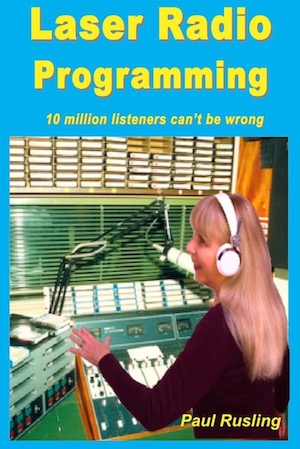
Paul's second book about LASER describes how just one radio ship attracted an audience of around 10 million in the 1980s.
Laser Radio Programming covers the format and theory of several offshore radio stations, including refences to stations such as Radio Caroline, Big L and SRE - Swinging Radio England.
Internet Radio 2016 is a 276 page softback book that sells for £19.95, but much of the information is also available in the newer book, ONLINE RADIO, published in November 2023.
There are still some copies of the Who's Who in British Radio 2002 available, direct from the publisher. This is a large thick book with details of many hundreds of people in the radio industry; it sold for £29.95 (plus postage!) at the time, but can now be had for just £5 a copy, plus £2.90 post and packing (to the UK only - EMail first for prices to other destinations)
Click Here for more details of
Laser Radio Programming;
a 'must read' book for
all radio fans and staff.
One of the most action packed stories of modern offshore radio, told by the people who were there! This book has details of the crooks and the crooks, some of the fraudsters, the Government blockade on supplies, an armed raid, take-overs and much more.
Who's Who in British Radio 2002
Over a dozen books written by Paul are still in print
The book launched as an eBook readable on Kindles, tablets, computers and any smartphone.
The guide is 353 pages long and it describes all the equipment needed, why and where it can be obtained; in many cases the price details are included and even has direct clickable links to the various suppliers.
Internet Radio 2016 was then published as a solid 276 page softback. Its just £19.95, and although an updated version is in preparation, even the old 2016 edition is crammed with heaps of relevant information.
Paul's first published work
Paul's first commissioned article was in 1973 for a radio magazine, aimed at radio listeners in the UK and called SCRIPT. In the article Paul told of life on Radio Caroline.
He wrote many further pieces over the years for titles as diverse as Practical Wireless, Ships Monthly and Billboard in the 1970s. The largest of these was a four page spread in Ships Monthly in the early 1980's which won two awards.
In the 1980's he also worked for the Yorkshire Post as a stringer and for the Sunday Times. His ST work included many commissioned articles, mostly about radio but also some items about the music business.
World Broadcast News
Paul then became the UK correspondent for World Broadcast News throughout the 1980s. World Broadcast News was a leading American publication covering radio stations around the world.
Mix Mag
In 1984 he was invited by Tony Prince to write for DMC (Disco Mix Club) - a glossy mag aimed at DJs and the clubbing scene. His occasional radio pieces were expanded into a regular monthly 'column' which eventually covered several pages of news from the radio business around the world.
Paul also chaired discussion panels on radio at the prestigious annual World DJ Convention held in London - usually at the Hippodrome or the Appollo and Dominion in the West End.
In 1995 Paul co-edited a book with his daughter Dawn called Who's Who in British Radio. This was a directory of people working in the radio business, in front of and behind the microphone. This sold so well they published a further edition in 2002 which was over 600 pages long.
(The 1996 edition of
Who's Who in British Radio
is now out of print)
Who's Who in British Radio 2002 met with considerable success, despite its hefty price tag of £29.95 per copy. For many years it has been an important reference work for many in the radio business.
Get a copy now for £5, plus P&P
Paul collated and edited a superb book called the Radio Caroline Bible, which tells the full story of the world's most famous offshore radio ship, from its genesis in 1964, up to the 2020s. Just as with any other bible, story is really that of several key people who ran Radio Caroline throughout its often dramatic life.
It's a lengthy tale, covering many hitherto untold stories of 'behind the scenes' events surrounding Radio Caroline. The book is illustrated with over three hundred photographs and drawings, many being published for the first time.
The book is available in hardback and in softback, is 538 pages long and can be ordered by Amazon, Waterstones, any good bookshop, the Radio Caroline webshop or direct from the publishers, World of Radio.
For more details of this book click on the book cover, or go to
Local Newspaper
From 1989 to 1991 Paul and his wife Anne published a weekly paid-for newspaper in East Yorkshire called the Haltemprice Herald. This was a weekly 'paid for' newspaper that covered the affluent villages to the west of the city of Hull.
It had a small team of 8 journalists, a great sales force and first class in-house production people who assembled the pages on Apple Mac computers - something that the larger newspaper groups had not yet discovered! Nowadays, all newspapers and quality magazines are 'made up' using QuarkXpress, which was the latest technology at that time.
Online Radio is the fastest-growing broadcast medium with over a hundred thousand radio stations now audible around the world online, via smart speakers and mobile phones.
This book explains the development and technology of radio in layman’s terms. It also discusses how analogue audio can be sliced to make digital signals which are easier to transmit. The requirements of online radio are then described, with a look at the essential studio equipment and at basic business plans for operating an online radio station. Funding online radio is discussed as are various new forms of revenue that are already revolutionising the medium.
This book explores how radio broadcasting developed and how digital has made transmission via the internet a viable way for new radio stations to access audiences. It identifies some of the pioneers who made online radio possible, despite the strenuous efforts to suppress new stations.
Online Radio is the fastest-growing broadcast medium with over a hundred thousand radio stations now audible around the world online, via smart speakers and mobile phones.
This book explains the development and technology of radio in layman’s terms. It also discusses how analogue audio can be sliced to make digital signals which are easier to transmit. The requirements of online radio are then described, with a look at the essential studio equipment and at basic business plans for operating an online radio station. Funding online radio is discussed as are various new forms of revenue that are already revolutionising the medium.
This book explores how radio broadcasting developed and how digital has made transmission via the internet a viable way for new radio stations to access audiences. It identifies some of the pioneers who made online radio possible, despite the strenuous efforts to suppress new stations.
A guide to Podcasting
This book describes what a podcast is and how its made, before guiding the reader through the history of the medium and the technical aspects of the equipment needed to produce a podcast. It also looks at who is distributing the podcasts and at some of the 'movers and shakers' in the industry, the main corporate players and sources of media coverage about this latest way to disseminate or obtain education, knowledge, news and entertainment.
Author Paul Rusling draws on his decades in radio broadcasting and podcast consulting to steer readers through the minefield of studio equipment, web host servers, directories, meta, distribution and audience metrics, to give a broad overview of this exciting new medium.
The story of how radio formats developed in the UK and the US. This new book tells how rigid regulation held up radio in Europe while stations in the US mushroomed and grew, to be worth many times those in the UK, pro-rata to population.Over 130 formats are described in the 100 page book which will be of interest to avid listeners, students and radio professionals alike.
ThePodcasting Guide book also explores the fascinating history of podcasts -
How did the phenomenum start?
Who were the leaders?
What product affected it most?
There are chapters about the current state of play, the future of podcasting and a section on technical aspects, including VIDEOCASTING. The book describes some of the equipment used in basic assembly of podcasts, including the TenLamp and Rodecaster Pro bundles, which include everything needed.